Every IRO knows the uncomfortable truth about the stock price: you don't control it. Earnings, macro, sector rotation, a single analyst's model — most of what moves the number sits outside your desk. So if the thing everyone watches isn't the thing you can move, what are you actually managing?
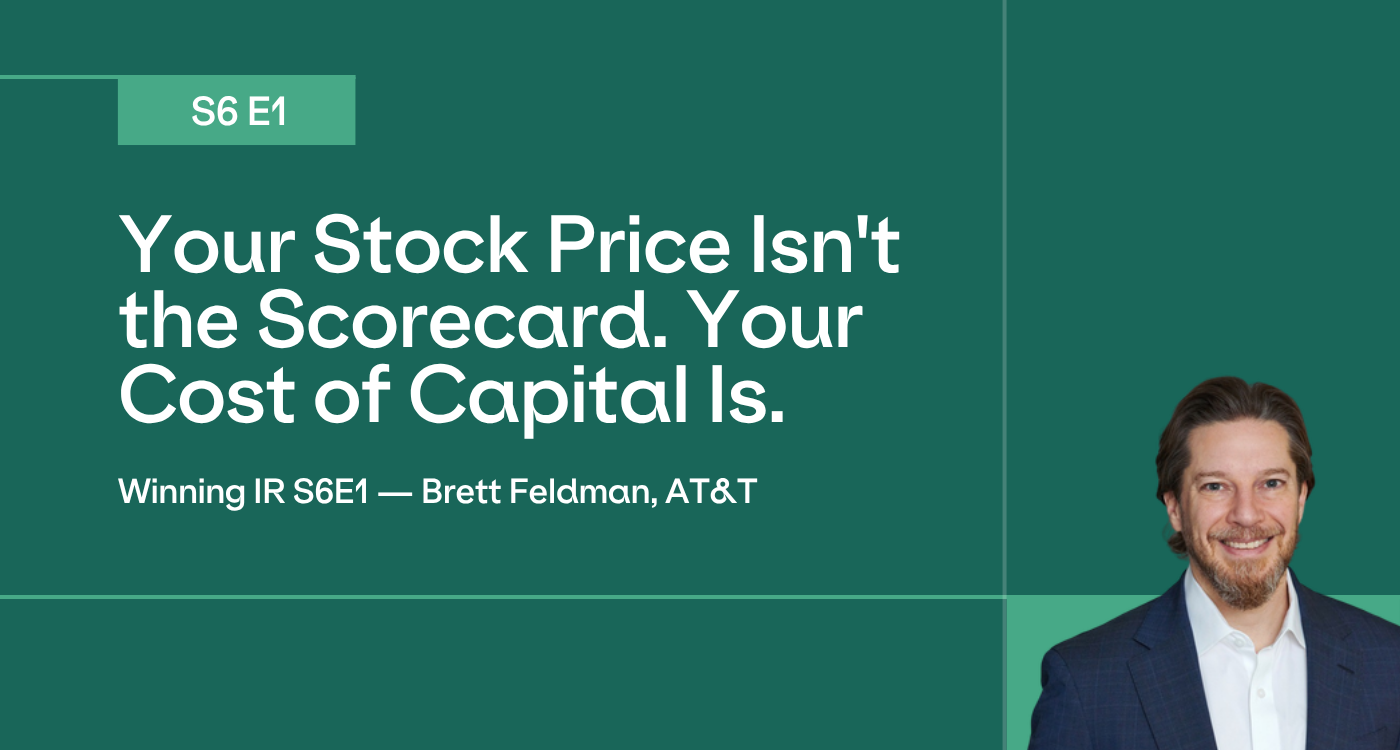
Brett Feldman has an answer. As SVP Investor Relations and Treasurer at AT&T, he runs IR for a company that's been public for nearly 150 years, carries a market cap north of $175 billion, and counts roughly a third of its shares in retail hands — many of them customers. Before that, he spent 20 years as a sell-side analyst. That full-circle view leads him to a claim most IR teams never make out loud: investor relations has exactly one job, and it shows up as a real number on the balance sheet.
IR has one job and it's not the share price
Feldman puts it bluntly. A public company isn't required to have an IR function at all. File your forms with the SEC accurately and on time, and you've met your disclosure obligations. Everything beyond that is discretionary spend — which, as he points out, tends to make CFOs sit up: "People don't like it when I say that in front of CFOs. They're like, you mean I can stop spending money on this?"
So why fund it? Because IR exists to do one thing: keep the market's perception of the company aligned with its internal reality. Not to push the stock up. Not to rack up meeting counts. To close the gap between what a company is and what the market believes it is — for better or worse, as tightly as possible.
That reframe matters because it changes what you measure. If the job is alignment, then the score isn't the price. It's whether the market sees the business clearly.
The financial case: perception gaps show up in beta
When the market keeps discovering it misunderstood a company, that surprise gets expressed as volatility. And volatility isn't just an investor-experience problem — it's a cost problem. Anyone who's built a weighted average cost of capital knows the Greek letter beta: relative volatility. The more volatile your equity, the higher your cost of capital.
Follow the chain to its end. A company earns an economic return by generating returns on invested capital above its cost of capital and the wider that gap, the more value it creates. So if you're inflating your cost of capital by being bad at explaining what you are, you're narrowing the very gap that produces shareholder returns. As Feldman frames it, poor communication doesn't just annoy investors. It quietly taxes the business.
There's a second cost, too: attention. "There's 3000 companies in a Russell 3000. I can go look at the other 2,999 of them." When investors can't get a clean read on your story, volatility rises and liquidity leaves — they simply move on. In a market that crowded, being hard to understand is its own penalty.
This is why the stock price is such a poor scorecard. As Feldman says, if share-price appreciation were the measure of IR, then "IROs at companies that are seeing share price appreciation are the most underpaid people in corporate America." Creating shareholder value is everyone's job. IR's specific contribution is alignment and alignment is measured in volatility, not in dollars per share.
The real metric: did the market react the way you expected?
If not the price, then what? Feldman's preferred measure is non-quantitative.
Every time you give the market something new and material — an earnings report, a conference presentation, an acquisition — you should be able to predict the response. When the actual reaction lands meaningfully off from what you anticipated, that's the signal you got something wrong. You didn't help leadership understand how the investment community would digest the news.
He points to tells most IROs would recognize but few treat as diagnostics. The Q&A that turns into a queue of clarifying questions — people trying to work out what you actually said, or whether it was new — means the message didn't land. The analyst who opens with "not to beat a dead horse here" is telling you something should have been in your prepared remarks and wasn't. And when analysts write up your results, do they emphasize what you consider the most important points, or something else entirely? That gap is your report card.
The strongest version of the test is a prediction you make in advance: before earnings, tell leadership what you expect the market to reward and where it might push back. Then check yourself against the tape. Over time, that's what makes you a trusted advisor internally — not whether the stock moved, but whether you consistently called how it would.
The part most companies overlook: internal IR
Most people picture IR as external work: the earnings calls, the conferences, the buy-side and sell-side conversations. Feldman spends as much time on the inside. If the people within the company — the board, senior leaders, operators at every level — don't understand how the public market processes what the business does, they can't make decisions aligned with shareholder value, and IR can't explain the company well either. The feedback loop runs both directions.
At AT&T that takes concrete forms like quarterly sentiment memos to the board, a near-weekly internal email to senior leaders translating what analysts are saying and why the stock moved, even quarterly videos to a workforce of 130,000-plus. Feldman doesn't assume most employees know what adjusted EBITDA is — "but I can say that profitability matters and here's why." The payoff is people finally seeing how their day job connects to the share price they may partly own.
Why this listening to this episode is worth your time
Everything above is the what — why alignment is the job and how to measure it. Feldman’s Winning IR episode is where he gets into the how: his "is this in English?" stress test for messaging, the "while" red flag he hunts for in earnings scripts, and — drawing on those two decades on the sell side — the three-pillar incentive structure (compliance, recognition, and corporate relationships) that actually drives analyst behavior. The last stretch reframes a lot of the awkward moments IROs have with analysts, and it's best heard in his own words.
.png)

.png)