.png)
An Interview with Mark Hayes, Founder & CEO of Breakwater Strategy
The capital markets are undergoing a fundamental shift. Investors aren't waiting around for quarterly earnings calls to adjust their valuation models; they are constantly testing, tweaking, and rewriting their thesis in real time.
To unpack what this means for corporate leaders and Investor Relations Officers (IROs), we sat down with Mark Hayes, Founder & CEO of Breakwater Strategy. He shared insights from his firm's extensive institutional investor research and outlined how IR must transform from a passive communication function into an active engine for value creation.
Q: You argue we’ve entered an era of "continuous underwriting." What does that mean, and how does it change the role of IR?
Mark Hayes: One metric captures this best: institutional investors are revisiting their underwriting of public companies at roughly six times the rate they were four years ago.1 They aren't rebuilding entire discounted cash flow (DCF) models every week, but they are continuously re-testing underlying assumptions—pricing power, capital intensity, competitive moats, and management credibility.
Quarterly earnings still matter because the financial numbers ultimately have to reconcile with the story. But by the time a quarter ends, the investment thesis may have already moved several times based on external data. We project that by 2027, 60% of the evidence investors use will originate outside the company.
For IR, this shifts the primary objective. You cannot control every piece of information or issue a press release every time an external signal appears. Instead, IROs must understand which core assumptions are moving in the market, recognize when external evidence gains credibility, and alert executive leadership when the market's view and management's view start to disconnect.
Q: What are the biggest gaps between what modern investors need and what IR teams typically provide?
Mark Hayes: Most companies are great at explaining what happened in the past quarter, but struggle to explain what happens next and why. In our institutional research:
- 96% of investors say they need different valuation information than three years ago.
- 82% say traditional IR practices must evolve.
- 64% of equity narratives are misaligned with investor information needs.
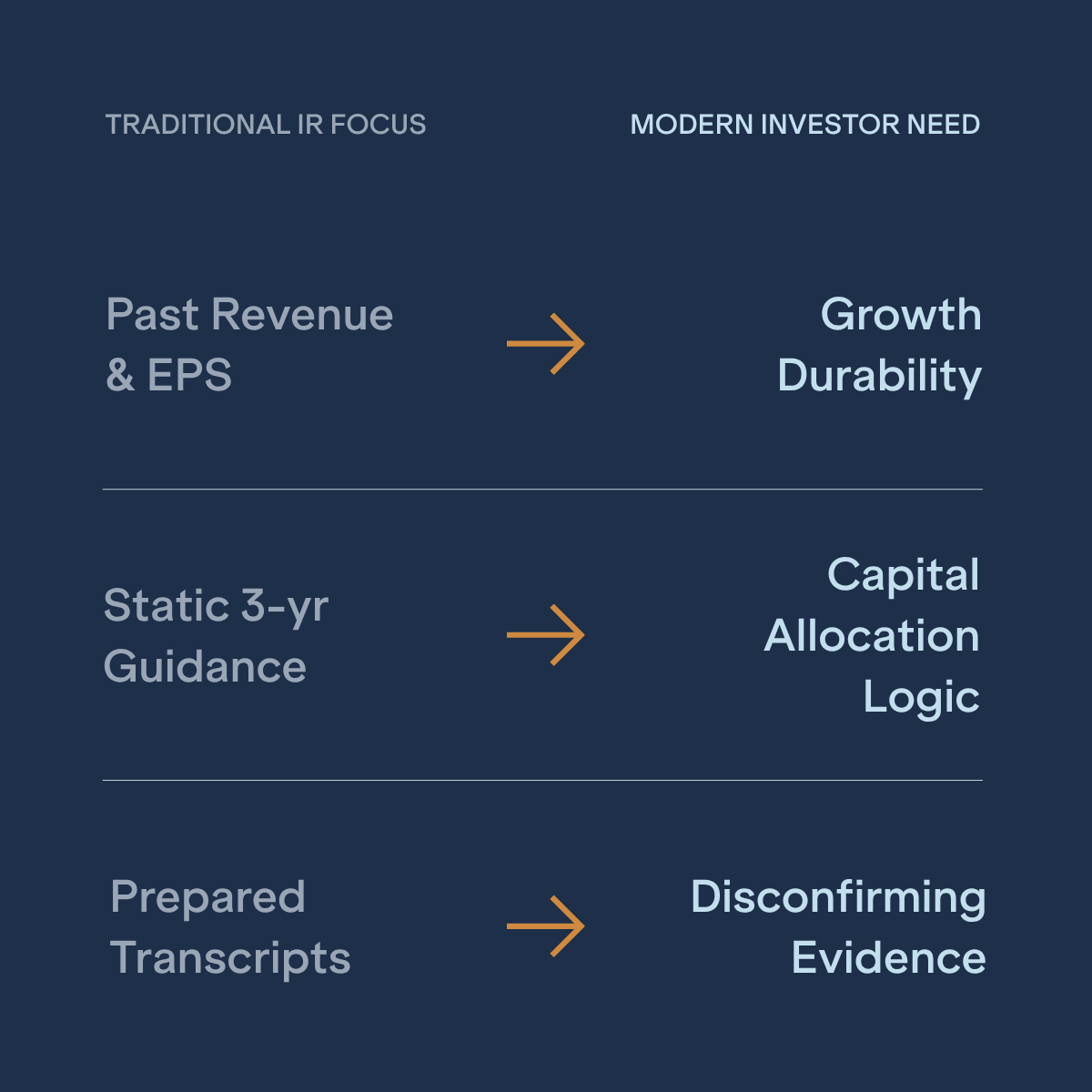
Furthermore, roughly 75% of S&P 500 equity value sits beyond year ten, yet only about 5% of companies discuss metrics beyond a five-year horizon on earnings calls.2 Investors aren't underwriting a static spreadsheet—they are underwriting management's ability to make good choices when today's forecast proves wrong. That disconnect explains why satisfaction with traditional earnings calls has dropped 26% since 2021.
Q: How are AI and alternative data changing how investors evaluate companies?
Mark Hayes: The obvious AI story is efficiency—summarizing filings or tracking language changes. But because every fund has those capabilities, summaries carry zero scarcity value.
The real shift is how AI alters the value of information:
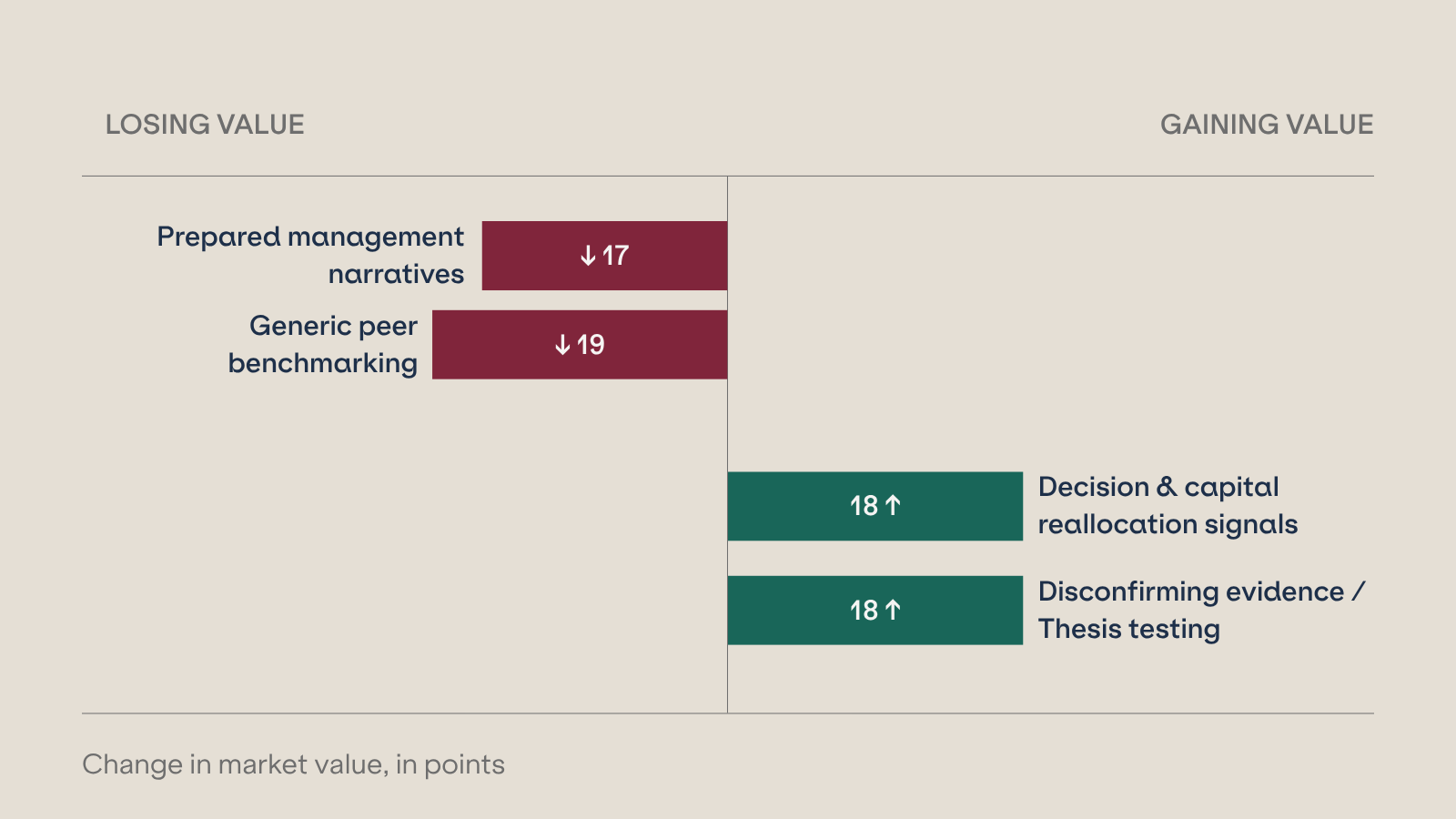
Meanwhile, alternative data (tracking web traffic, hiring shifts, supply chain flows) lets investors identify demand changes before they hit official disclosures. This makes executive judgment more critical, not less. Investors want to see what management actually does when facts change—where capital moves, which initiatives are killed, and how resources shift. Resource allocation reveals true conviction.
Q: What specific proof are investors looking for to build long-term conviction?
Mark Hayes: Investors want direct economic proof. Buzzwords like "agile" or "AI-enabled" don't create value unless they show up in margins, cash flow conversion, or returns on capital.
- Business-Model Adaptability: Rose from 72 to 93
- Management Decision Quality: Rose from 78 to 92
- Competitive Advantage Duration: Rose from 81 to 91
- Near-Term EPS Delivery: Fell from 81 to 71
Take AI as an example: slide decks showing AI pilots no longer suffice. Investors want to know how AI impacts pricing power, unit economics, customer retention, and incremental Return on Invested Capital (ROIC).
Q: What key adjustments should IR leaders make over the next 12 to 24 months?
Mark Hayes: Start with the core variables driving your valuation model rather than starting with communication tactics. I recommend four immediate shifts:
1. Map Your Value Drivers:
Understand how key business inputs tie to long-term ROIC, free cash flow conversion, and risk profile.
2. Audit External Translation:
Identify where sell-side and buy-side models diverge from management’s internal calculations.
3. Upgrade Investor Days:
Move away from long corporate presentations. Redesign Investor Days around decision frameworks, capital allocation rules, and scenario logic.
4. Establish Machine-Readability:
Ensure disclosures are structured and clear enough for both human analysts and AI research workflows to parse without distorting facts.
Q: Looking ahead to 2030, what will separate top-tier IR teams from the rest?
Mark Hayes: The highest-performing IR teams will act as strategic intelligence hubs for executive teams and boards.
By 2030, AI systems will maintain complete institutional memory across disclosures, transcripts, competitor actions, and market expectations. When management speaks, automated systems will cross-reference claims against prior actions and external evidence instantly.
Great IROs won't just publish materials; they will manage an "always-on" interpretation framework. They will flag belief gaps before they become valuation discounts, explain long-term organizational adaptability, and help management use market feedback to allocate capital more effectively.
Key Takeaways for IR Professionals
- Continuous Underwriting is the Baseline: Investors update assumptions constantly using external alternative data.
- Proof Over Rhetoric: Quantify productivity, capital allocation logic, and ROI rather than relying on high-level narratives.
- Structure Communications for AI & Humans: Ensure core metrics, definitions, and causal linkages are clearly structured for machine ingestion.
- Connect IR to Internal Strategy: Bring capital market intelligence back to executive leadership to refine decision-making and protect long-term enterprise value.
1, 2 - Source: Breakwater Capital Markets, proprietary primary research; [2026]
.png)

.png)